Posts

Showing posts with the label Ecosystem impact

Olive bioeconomics under climate warming
Image
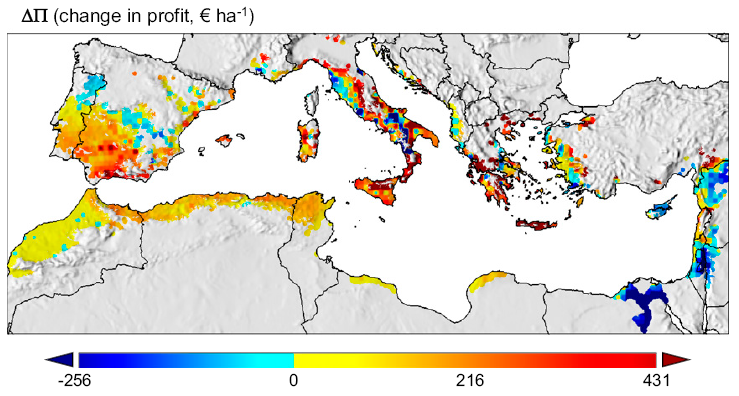
Inability to determine reliably the direction and magnitude of change in natural and agro-ecosystems due to climate change poses considerable challenge to their management. Olive is an ancient ubiquitous crop having considerable ecological and socioeconomic importance in the Mediterranean Basin. We assess the ecological and economic impact of projected 1.8 °C climate warming on olive and its obligate pest, the olive fly. This level of climate warming will have varying impact on olive yield and fly infestation levels across the Mediterranean Basin, and result in economic winners and losers. The analysis predicts areas of decreased profitability that will increase the risk of abandonment of small farms in marginal areas critical to soil and biodiversity conservation and to fire risk reduction. Ponti L., Gutierrez A.P., Ruti P.M., Dell’Aquila A., 2014. Fine scale ecological and economic assessment of climate change on olive in the Mediterranean Basin reveals winners and losers. Procee...
Process-based soil water balance for olive

Image
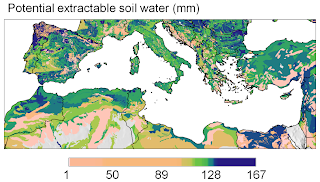
Olive is of major eco-social importance for the desertification-prone Mediterranean Basin, a climate change and biodiversity hotspot of global relevance where remarkable climate change is expected over the next few decades with unknown ecosystem impacts. However, climate impact assessments have long been constrained by a narrow methodological basis (ecological niche models, ENMs) that is correlative and hence largely omits key impact drivers such as trophic interactions and the effect of water availability. To bridge this gap, mechanistic approaches such as physiologically-based weather-driven demographic models (PBDMs) may be used as they embed by design both the biology of trophic interactions and a mechanistic representation of soil water balance. Here we report progress towards assessing climate effects on olive culture across the Mediterranean region using mechanistic PBDMs that project regionally the multitrophic population dynamics of olive and olive fly as affected by daily wea...

Agriculture, food security and climate change in Europe

Image
The GlobalChangeBiology project is part of the Joint Programming Initiative on Agriculture, Food Security and Climate Change ( FACCE – JPI ) funded by the European Union under the 7th Framework Program. The goal of FACCE – JPI is to achieve, support and promote integration, alignment and joint implementation of national resources under a common research and innovation strategy to address the diverse challenges in agriculture, food security and climate change. Partnering MACSUR , the first pilot action of FACCE – JPI that will start officially in June 2012 (see first newsletter ), the GlobalChangeBiology project will provide case studies on grape and olive systems in the Mediterranean Basin. The MACSUR project is a knowledge hub that brings together 73 research groups from across Europe and will provide a detailed climate change risk assessment for European agriculture and food security, in collaboration with international projects including the GlobalChangeBiology project . As...

Project summary

Analytical tools that provide a synthesis of ecological data are increasingly needed to design and maintain sustainable agroecosystems increasingly disrupted by global change in the form of agro-technical inputs, invasive species, and climate change. This is particularly relevant to the Mediterranean Basin, a climate change hot-spot already threatened by local environmental changes including desertification. The project will provide important tools for summarizing, managing, and analyzing ecological data in agricultural systems to address global change effects using grape and olive as model systems. The project will integrate weather driven physiologically based Ecosystem Modelling (EM) and Geographic Information Systems (GIS) to derive a dynamic understanding of complex agricultural systems in the face of global change including climate warming. Multivariate analyses will be used to summarize the main effect of model predictions in a space and time independent way to provide a solid b...