Posts

Showing posts with the label sustainability

Resilience to climate change in agricultural systems

Image
Climate change is impacting agroecosystems widely. Ecological connectivity makes regions more resilient and hence helps conserve biodiversity and combat climate change, while ecologically sound analysis and management help keep agroecosystems alive. In this context, a bioeconomic approach may help guide the integration of natural and human systems. In Umbria, the origin of this approach was the opening lecture of TreviNatura (Trevi, Italy 25-27 October 2015) delivered by Professor Andrew P. Gutierrez ( CASAS Global ) and titled  " The economy of nature and humans: the role of ecosystem services " that illustrated the often conflicting interaction between humans and nature, and how this interaction can be best understood using bioeconomics, with ecosystem services playing a central role. The region of Umbria in Central Italy is particularly amenable to developing and implementing a holistic approach to the integrated management of agricultural and natural ecosystems, because t...

GlobalChangeBiology project story published

Image
A story about the GlobalChangeBiology project was published on the Horizon 2020 website in the Projects Stories section. The European Commission DG Research had commissioned an article on the GlobalChangeBiology project for publication on the DG Research website under “success stories”. After an interview by a professional writer, the article was prepared and eventually selected for publication on the official website of the European Commission. European Commission, 2014. Modelling climate impacts on crops and pests. http://ec.europa.eu/programmes/horizon2020/en/news/modelling-climate-impacts-crops-and-pests

Bioeconomic sustainability of cellulosic biofuel production

Image
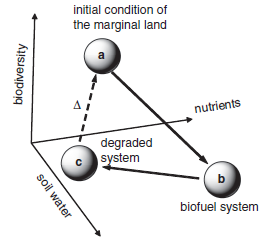
The use of marginal land (ML) for lignocellulosic biofuel production is examined for system stability, resilience, and eco-social sustainability. A North American prairie grass system and its industrialization for maximum biomass production using biotechnology and agro-technical inputs is the focus of the analysis. Demographic models of ML biomass production and ethanol farmer/producers are used to examine the stability properties of the ML system. A bio-economic model that maximizes the utility of consumption having the dynamics of MLs and the farmer/producers as dynamic constraints is used to examine the effects of increased conversion efficiency, input costs, risk, and levels of base resources and inputs on the competitive and societal solutions for biomass production. We posit ML abandonment after biofuel production ceases could lead to permanent land degradation below initial levels that prohibit the establishment of the original flora and fauna. Gutierrez A.P., Ponti L., 2009. ...