Posts

Showing posts with the label Invasive species

Invasive potential of tropical fruit flies in temperate regions under climate change

Image
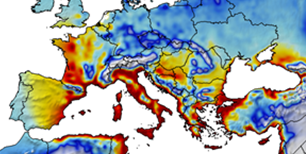
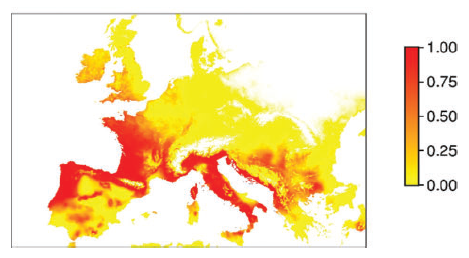
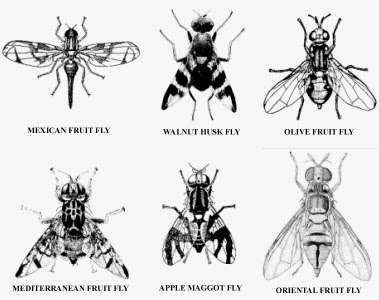
Tropical fruit flies are considered among the most economically important invasive species detected in temperate areas of the United States and the European Union. Detections often trigger quarantine and eradication programs that are conducted without a holistic understanding of the threat posed. Weather-driven physiologically-based demographic models are used to estimate the geographic range, relative abundance, and threat posed by four tropical tephritid fruit flies (Mediterranean fruit fly, melon fly, oriental fruit fly, and Mexican fruit fly) in North and Central America, and the European-Mediterranean region under extant and climate change weather (RCP8.5 and A1B scenarios). Most temperate areas under tropical fruit fly propagule pressure have not been suitable for establishment, but suitability is predicted to increase in some areas with climate change. To meet this ongoing challenge, investments are needed to collect sound biological data to develop mechanistic models to predict...

Impact of low temperature and host plant on Tuta absoluta

Image
Alternative host plants are among the key factors influencing the spread of invasive pests because they are utilized as a food source and provide shelter in unfavorable conditions. The South American tomato pinworm (SATP), Tuta absoluta Meyrick (Lepidoptera: Gelechiidae), has a high behavioral and physiological plasticity enabling it to rapidly spread in several countries. Among the multiple strategies used by SATP in the invasion process is the use of alternative host plants including black nightshade (BNS), Solanum nigrum L. (Solanaceae), a perennial plant widely distributed across all habitats worldwide. Besides the life table and behavioral parameters of SATP on tomato, its survival and reproduction in low temperatures on alternative host plants should be assessed to evaluate the likely spread in temperate regions with harsh winters. In our study, comparing solanaceous species through generations, the primary difference was in the mean generation time with SATP reared on BNS, whe...

Why was the invasion risk of Tuta absoluta underestimated?

Image
The capacity to assess invasion risk from potential crop pests before invasion of new regions globally would be invaluable, but this requires the ability to predict accurately their potential geographic range and relative abundance in novel areas. This may be unachievable using de facto standard correlative methods as shown for the South American tomato pinworm Tuta absoluta , a serious insect pest of tomato native to South America. Its global invasive potential was not identified until after rapid invasion of Europe, followed by Africa and parts of Asia where it has become a major food security problem on solanaceous crops. Early prospective assessment of its potential range is possible using physiologically based demographic modeling that would have identified knowledge gaps in T. absoluta biology at low temperatures. Physiologically based demographic models (PBDMs) realistically capture the weather-driven biology in a mechanistic way allowing evaluation of invasive risk in novel ar...

Thermal biology of Tuta absoluta: demographic parameters and facultative diapause

Image
The South American tomato pinworm, Tuta absoluta , (SATP) is now a devastating pest worldwide of crops in the family Solanaceae. Most prior studies of SATP’s thermal biology were based on populations from tropical regions, and proved unsuitable for explaining its invasion of large areas of the Palearctic. A more holistic approach to the analysis of its thermal biology is essential background for developing models to assess its invasive potential. Our studies found that SATP has lower and upper thermal thresholds (θ L  = 5.37 °C and θ U = 35.69 °C, respectively) than South American populations used in prior studies (θ L = 7.38 °C and θ U = 33.82 °C). Age-specific life tables were used to estimate the effects of temperature on its demographic parameters. Diapause in SATP had not been characterized prior to our study. We found facultative diapause in pupae developing from larvae exposed to relatively low temperatures (i.e., 2 and 5 °C) and short-day length for different exposure period...

Establishment and impact of tiger mosquito in Europe

Image
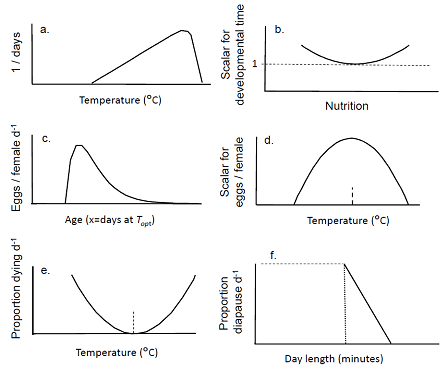
The Asian tiger mosquito ( Aedes albopictus ) is one of the most invasive disease vectors worldwide. The species is a competent vector of dengue, chikungunya, Zika viruses and other severe parasites and pathogens threatening human health. The capacity of this mosquito to colonize and establish in new areas (including temperate regions) is enhanced by its ability of producing diapausing eggs that survive relatively cold winters. The main drivers of population dynamics for this mosquito are water and air temperature and photoperiod. In this paper, we present a mechanistic model that predicts the potential distribution, abundance and activity of Asian tiger mosquito in Europe. The model includes a comprehensive description of: i) the individual life-history strategies, including diapause, ii) the influence of weather-driven individual physiological responses on population dynamics and iii) the density-dependent regulation of larval mortality rate. The model is calibrated using field data ...

Crop-pest dynamics in the Mediterranean Basin

Image
Climate change will make assessing and managing crop-pest systems in the Mediterranean Basin more difficult than elsewhere on the globe. The Basin is in many ways a hot spot of global change, as higher than average projected climate change threatens an extremely rich and intertwined biological and cultural diversity, and increases its vulnerability to biological invasions. As a consequence, pest problems in this hot spot will require a holistic approach to deconstruct the elusive complex interactions that are the underpinning basis for sound decision making at the field level. Building on 30+ years of multidisciplinary progress inspired by pioneering work at University of California , the ENEA GlobalChangeBiology project in collaboration with CASAS Global is developing an interdisciplinary tool to mechanistically describe (i.e., model), analyze and manage agro-ecological problems based on the unifying paradigm that all organisms including humans acquire and allocate resources by analog...

Invasiveness of spotted wing Drosophila

Image
The polyphagous Asian vinegar fly Drosophila suzukii (spotted wing Drosophila) is a native of Eastern and Southeastern Asia. It emerged as an important invasive insect pest of berries and stone fruits in the Americas and Europe beginning in 2008. Species distribution models are commonly used for analyzing the extant and potential range expansion of invasive species. Previous modeling efforts for D. suzukii include a degree-day model, a MaxEnt ecological niche model, a demographic model incorporating the effects of temperature, and a preliminary mechanistic physiologically-based demographic model (PBDM). In the present analysis, we refine the PBDM for D. suzukii based on biological data reported in the literature. The PBDM is used to assess the effects of temperature and relative humidity from a recently published global climate dataset (AgMERRA) on the prospective geographic distribution and relative abundance of the pest in the USA and Mexico, and in Europe and the Mediterranean Ba...

Invasion biology of Drosophila suzukii

Image
The Asian vinegar fly Drosophila suzukii [spotted wing Drosophila (SWD)] has emerged as a major invasive insect pest of small and stone fruits in both the Americas and Europe since the late 2000s. While research efforts have rapidly progressed in Asia, North America, and Europe over the past 5 years, important new insights may be gained in comparing and contrasting findings across the regions affected by SWD. In this review, common themes in the invasion biology of SWD are explored by examining (1) its biology and current pest status in endemic and recently invaded regions; (2) current efforts and future research needs for the development of predictive models for its geographic expansion; and (3) prospects for both natural and classical (=importation) biological control of SWD in invaded habitats, with emphasis on the role of hymenopteran parasitoids. The review concludes that particularly fruitful areas of research should include fundamental studies of its overwintering, host-use, and...

Agrobiodiversity in a changing world

Image
Exotic species that invade new areas cause economic loss annually nearly tenfold that of natural disasters. The economic impact of such biological invasions has been considerable also in agriculture, with many major agricultural pests being invasive species, which number is expected to increase given the combined action of climate warming and globalization, particularly in the Mediterranean Basin. This region is rich in natural and agricultural biodiversity but also considerably vulnerable to biological invasions that threaten key elements of Mediterranean agro-biodiversity such as the traditional perennial crops grape and olive. Currently, most major threats to grape and olive culture are invasive species - often vector borne diseases so serious that the only control method is removal and destruction of infected crop plants. However, how to assess the potential impact of such invasive threats, and hence how to manage them, remains an unresolved and largely unexplored problem. Gaps exi...

Risk assessment for tiger mosquito in Europe

Image
The Asian tiger mosquito ( Ae. albopictus ) is indigenous to the oriental region, but is now widespread throughout the world. It is an aggressive mosquito, which causes nuisance and is well known vector of important human disease. It is one of the world’s most invasive species and is now invading Europe by both natural means and human assisted dispersal. Currently, there is no consensus on the limits of its potential geographic distribution in Europe. For this reason, studying the role that environmental driving variables, mainly temperature, play in determining the spatial variation of the potential population abundance of the mosquito should be considered a high priority. To assess the risk posed by Ae. albopictus to Europe, a lattice model based on the temperature-dependent physiologically based demographic modelling approach has been developed and is being tested against field observations. The area of potential distribution of this insect is simulated as driven by current climate...

Remote sensing and invasive species

Image
A crucial step in evaluating the impact of invasive species is to map changes in their actual and potential distribution and relative abundance across wide regions over an appropriate time span. While direct and indirect remote sensing approaches have long been used to assess the invasion of plant species, the distribution of invasive animals is mainly based on indirect methods that rely on environmental proxies of conditions suitable for colonization by a particular species. The aim of this article is to review recent efforts in the predictive modelling of the spread of both plant and animal invasive species using remote sensing, and to stimulate debate on the potential use of remote sensing in biological invasion monitoring and forecasting. Rocchini D., Andreo V., Förster M., Garzon-Lopez C.X., Gutierrez A.P., Gillespie T.W., Hauffe H.C., He K.S., Kleinschmit B., Mairota P., Marcantonio M., Metz M., Nagendra H., Pareeth S., Ponti L., Ricotta C., Rizzoli A., Schaab G., Zebisch M., Z...

Holistic approach in invasive species research

Image
The Mediterranean Basin is a climate change and biological invasion hotspot where recent warming is facilitating the establishment and spread of invasive species, one of which is the highly destructive South American tomato leafminer ( Tuta absoluta ). This pest recently invaded the Mediterranean Basin where it threatens solanaceous crops. Holistic approaches are required to project the potential geographic distribution and relative abundance of invasive species and hence are pivotal to developing sound policy for their management. This need is increasing dramatically in the face of a surge in biological invasions and climate change. However, while holistic analyses of invasive species are often advocated, they are rarely implemented. We propose that physiologically-based demographic models (PBDMs) in the context of a geographic information system (GIS) can provide the appropriate level of synthesis required to capture the complex interactions basic to manage invasive species such as T...

Invasive species and climate change: the PBDM approach

Image
Assessing the geographic distribution and abundance of invasive species is critical for developing sound management and/or eradication policies. Ecological niche modelling approaches (ENMs) that make implicit assumptions about biology and mathematics are commonly used to predict the potential distribution of invasive species based on their recorded distribution. An alternative approach is physiologically based demographic modelling (PBDM), which explicitly incorporates the mathematics and the observed biology, including trophic interactions, to predict the temporal phenology and dynamics of a species across wide geographic areas. The invasive weed, yellow starthistle (YST) (Centaurea solstitialis), and its interactions with annual grasses and herbivorous biological control agents is used to demonstrate the utility of the PBDM approach for analysing complex invasive species problems. The PBDM predicts the distribution and relative abundance of YST accurately across the western USA, and ...

Analysis of invasive insects: links to climate change

Image
Climate change is expected to alter the geographic distribution and abundance of many species, to increase the invasion of new areas by exotic species and, in some cases, to lead to extinction of species. This chapter reviews some of the links between invasive insects and climate change. The effects of climate change on insect pest populations can be direct, through impacts on their physiology and behaviour, or indirect, through biotic interactions (i.e. bottom-up and top-down eff ects). Anthropogenic climate and global change is expected to be a major driver in the introduction, establishment, distribution, impact and changes in the efficacy of mitigation strategies for invasive species. To address these problems, we must be able to predict climate change impacts on species distribution and abundance. Commonly used ecological niche modelling approaches have implicit assumptions about the biology of the target species and attempt to characterize the ecological niche using aggregate wea...

Ultra-low, cryptic tropical fruit fly populations

Image
A comment appeared in Proceedings B reviews a study by Papadopoulos, Plant, and Carey (2013; "From trickle to flood: the large-scale, cryptic invasion of California by tropical fruit flies." Proc. R. Soc. B: Biol. Sci. 280: http://dx.doi.org/10.1098/rspb.2013.1466 ) and suggests an alternative approach that addresses the biology of invasive species. In summary, inference of establishment of fruit flies based on recurrence data as performed by Papadopoulos et al. (2013) is neither explanatory nor provides confirmation of establishment in California. By contrast, physiologically based demographic models for medfly and olive fly accurately predict the potential distribution of the two fruit flies in California and elsewhere, and provide explanation for species phenology and dynamics that is critical for risk assessment and policy development for these and other invasive species under current climate and climate change scenarios. Gutierrez A.P., Ponti L., Gilioli G., 2014. Comm...

Asian citrus psyllid and citrus greening disease

Image
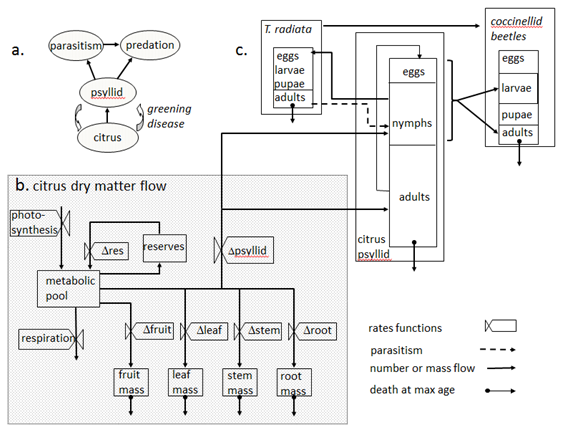
The invasive Asian citrus psyllid Diaphorina citri Kuwayama vectors the bacterial pathogen ‘Candidatus Liberibacter asiaticus’ that is the putative causal agent of citrus greening disease (Huanglongbing disease) in citrus in many areas of the world. The capacity to predict the potential geographic distribution, phenology and relative abundance of the pest and disease is pivotal to developing sound policy for their management. A weather-driven physiologically based demographic model (PBDM) system is developed that summarizes the available data in the literature, and used to assess prospectively the geographic distribution and relative abundance of citrus, the psyllid, its parasitoid ( Tamarixia radiata Waterston), and citrus greening disease in North America and the Mediterranean Basin. The potential for natural and biological control of citrus psyllid is examined prospectively. Gutierrez A.P., Ponti L., 2013. Prospective analysis of the geographic distribution and relative abundance...

Invasive species: why the biology matters

Image
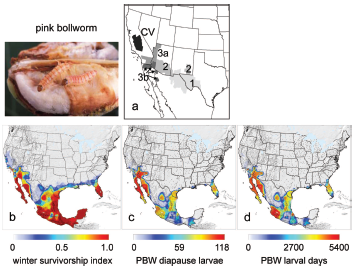
Using published bi- and tri-trophic physiologically-based demographic system models having similar sub components, the geographic distributions and relative abundance (a measure of invasiveness) of six invasive herbivorous insect species is assessed prospectively across the United States and Mexico. The models used are mechanistic descriptions of the weather-driven biology of the species. The plant hosts and insect species included in the study are: (1) cotton/pink bollworm, (2) a fruit tree host/Mediterranean fruit fly, (3) olive/olive fly, (4) a perennial host/light brown apple moth; (5) grapevine/glassy-winged sharpshooter and its two egg parasitoids, (6) grapevine/European grapevine moth. All of these species are currently or have been targets for eradication. The goal of the analyses is to predict and explain prospectively the disparate distributions of the six species as a basis for examining eradication/containment efforts against them. The eradication of the new world screwworm...

Agroecological management of invasive species

Image
During a meeting of the Italian National Academy of Entomology held in Florence on 18 February 2012, Luigi Ponti delivered a public lecture titled "Management of invasive species in the frame of an agro-ecological vision: the case study of Tuta absoluta (Meyrick)". The talk was part of a workshop on T. absoluta where Italian research stakeholders reported on this major invasive pest problem for the Mediterranean Basin. Dr. Ponti's talk focused on how physiologically-based weather-driven demographic models ( CASAS models) integrated into a GIS may aid ecologically-based management of invasive species such as T. absoluta by sorting out the complexity of the global change biology involved. Examples of how invasive species can be assessed in the frame of an agro-ecological vision were provided and prospective applications to T. absoluta outlined along with common misunderstanding about invasive species that may be clarified using the modeling approach of the GlobalChang...

Prospective analysis of European grapevine moth

Image
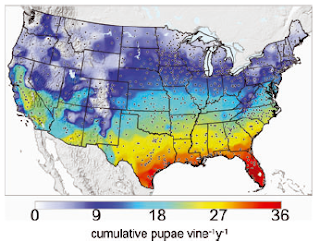
The polyphagous European grapevine moth Lobesia botrana (Den. & Schiff.) is the principal native pest of grape berries in the Palearctic region. It was found in Napa County, California, in 2009, and it has subsequently been recorded in an additional nine counties, despite an ongoing eradication program. A holistic physiologically-based demographic model for L. botrana linked to an extant mechanistic model of grapevine was run using observed daily weather data to simulate and map (via GRASS GIS ) the potential distribution of the moth in California and the continental U.S.A. The model predicts L. botrana can spread statewide with the highest populations expected in the hotter regions of southern California and the lower half of the Central Valley. In the U.S.A., areas of highest favorability include south Texas, and much of the southeast U.S.A. With climate warming, L. botrana abundance is expected to increase in northern California and in the agriculturally rich Central Valley ...

Analysis of the glassy-winged sharpshooter system

Image
The capacity to predict the geographic distribution and relative abundance of invasive species is pivotal to developing policy for eradication or control and management. An example is the glassy-winged sharpshooter Homalodisca vitripennis (Germar) (GWSS) in California which vectors the bacterial pathogen Xylella fastidiosa (Wells) that causes Pierce’s disease in grape and scorch-like diseases in other plants. A weather driven demographic model of grape, GWSS, its two parasitoids ( Gonatocerus ashmeadi Girault and G. triguttatus Girault) and the pathogen was developed to show how the geographic distribution and abundance of GWSS as affected by weather and natural enemies in California can be easily assessed. The distribution of X. fastidiosa is limited to the warm inland areas of southern California. Biological control of GWSS further decreases the pathogen's relative range. Two climate warming scenarios show that increasing temperatures will increase GWSS severity in the agric...