Posts

Showing posts with the label traditional farming systems

Long-distance dispersal boosts Xylella epidemics
Image
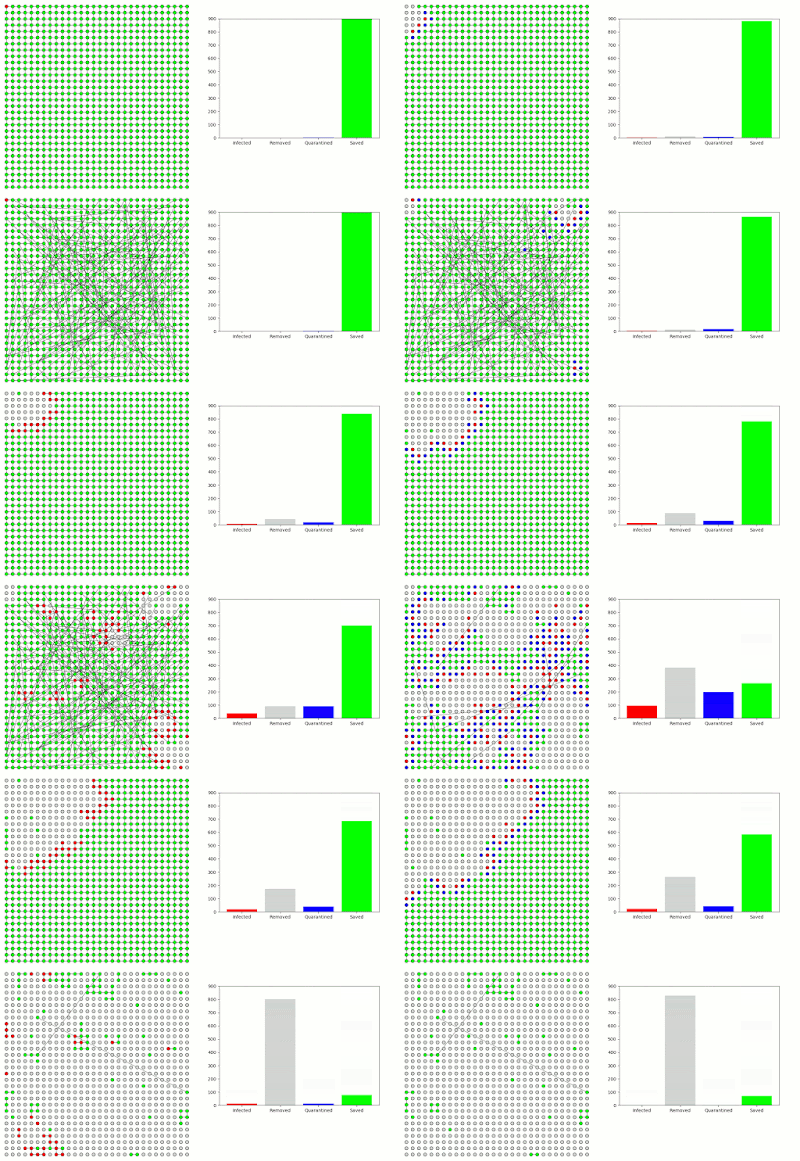
Outbreaks of a plant disease in a landscape can be meaningfully modelled using networks with nodes representing individual crop-fields, and edges representing potential infection pathways between them. Their spatial structure, which resembles that of a regular lattice, makes such networks fairly robust against epidemics. Yet, it is well-known how the addition of a few shortcuts can turn robust regular lattices into vulnerable ‘small world’ networks. Although the relevance of this phenomenon has been shown theoretically for networks with nodes corresponding to individual host plants, its real-world implications at a larger scale (i.e. in networks with nodes representing crop fields or other plantations) remain elusive. Focusing on realistic spatial networks connecting olive orchards in Andalusia (Southern Spain), the world’s leading olive producer, we show how even very small probabilities of long distance dispersal of infectious vectors result in a small-world effect that dramatically ...

International agroecology short course

Image
There is no doubt that humanity needs an alternative agricultural development paradigm, one that encourages more ecologically sound, biodiverse, resilient, sustainable, and socially just forms of agriculture. The basis for such new systems are the myriad of ecologically based agricultural styles developed on hundreds of millions small farms that produce a large share of the food consumed today in the world, mostly without agrochemicals. Agroecology represents this paradigm: a dialogue of wisdoms between traditional agricultural knowledges and modern agricultural sciences that uses ecological concepts and principles for the design and management of sustainable agroecosystems where external inputs are replaced by natural processes. This international Agroecology short course was held from May 2nd to 5th, 2018 at the Center for “Climate Change and Biodiversity in Lakes and Wetlands” located on Polvese Island , Lake Trasimeno, Umbria (Italy), and was designed for scholars, students, farmer...

Traditional farming and the Mediterranean diet

Image
The Mediterranean diet is described by the UNESCO Cultural Heritage of Humanity website ( http://www.unesco.org/culture/ich/en/RL/00884 ) as encompassing more than just food of the various cultures. These diets are embedded in bio-cultural landscapes that are at risk from global markets, industrial agriculture, invasive species and climate change, and yet little research aimed at conserving this Mediterranean agricultural heritage is being conducted. A focus on preserving traditional Mediterranean agricultural systems provides unique opportunities to link UNESCO-SCBD’s Joint Programme on Biological and Cultural Diversity ( http://www.cbd.int/lbcd/ ​) and FAO’s Globally Important Agricultural Heritage Systems initiative (GIAHS, http://www.fao.org/giahs/ ) with the goal of developing strategies and policy to preserve this heritage and the food production systems that are its basis for future generations. An important step in this direction is the development of holistic ecosystem-level a...