Posts

Showing posts with the label olive fly

Invasive potential of tropical fruit flies in temperate regions under climate change

Image
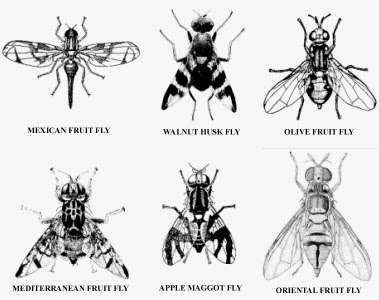
Tropical fruit flies are considered among the most economically important invasive species detected in temperate areas of the United States and the European Union. Detections often trigger quarantine and eradication programs that are conducted without a holistic understanding of the threat posed. Weather-driven physiologically-based demographic models are used to estimate the geographic range, relative abundance, and threat posed by four tropical tephritid fruit flies (Mediterranean fruit fly, melon fly, oriental fruit fly, and Mexican fruit fly) in North and Central America, and the European-Mediterranean region under extant and climate change weather (RCP8.5 and A1B scenarios). Most temperate areas under tropical fruit fly propagule pressure have not been suitable for establishment, but suitability is predicted to increase in some areas with climate change. To meet this ongoing challenge, investments are needed to collect sound biological data to develop mechanistic models to predict...

MED-GOLD project proposal selected for funding

Image
MED-GOLD ( Turning climate-related information into added value for traditional MEDiterranean Grape, OLive, and Durum wheat food systems ) will demonstrate the proof-of-concept for climate services in the agriculture sector by developing case studies for three hallmarks of the Mediterranean food system: grapes, olives, and durum wheat.  Agriculture is primarily climate-driven and hence highly vulnerable to climate variability and change. Evidence suggests that the Mediterranean region is under immediate threat of shifting climate patterns and the associated ecological, economic and social effects. Developing a capacity to turn the increasingly big climate-related data into tailored climate services that can inform decision-making in agriculture is, therefore, a priority both in Europe and worldwide. The long-term goal of this project is to make European agriculture and food systems more competitive, resilient, and efficient in the face of climate change, by using climate serv...

Analysis of invasive insects: links to climate change

Image
Climate change is expected to alter the geographic distribution and abundance of many species, to increase the invasion of new areas by exotic species and, in some cases, to lead to extinction of species. This chapter reviews some of the links between invasive insects and climate change. The effects of climate change on insect pest populations can be direct, through impacts on their physiology and behaviour, or indirect, through biotic interactions (i.e. bottom-up and top-down eff ects). Anthropogenic climate and global change is expected to be a major driver in the introduction, establishment, distribution, impact and changes in the efficacy of mitigation strategies for invasive species. To address these problems, we must be able to predict climate change impacts on species distribution and abundance. Commonly used ecological niche modelling approaches have implicit assumptions about the biology of the target species and attempt to characterize the ecological niche using aggregate wea...

Olive bioeconomics under climate warming

Image
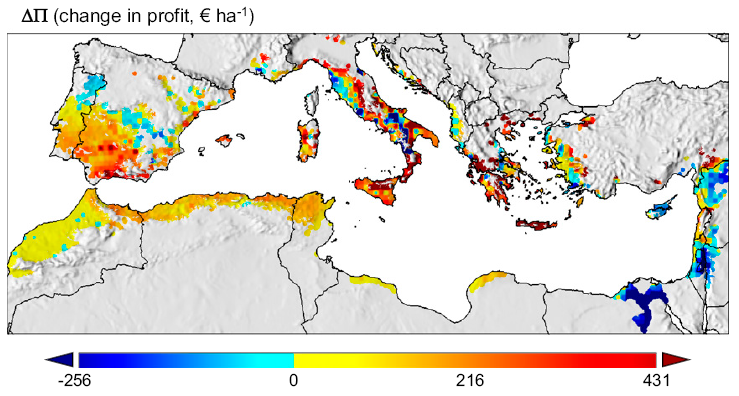
Inability to determine reliably the direction and magnitude of change in natural and agro-ecosystems due to climate change poses considerable challenge to their management. Olive is an ancient ubiquitous crop having considerable ecological and socioeconomic importance in the Mediterranean Basin. We assess the ecological and economic impact of projected 1.8 °C climate warming on olive and its obligate pest, the olive fly. This level of climate warming will have varying impact on olive yield and fly infestation levels across the Mediterranean Basin, and result in economic winners and losers. The analysis predicts areas of decreased profitability that will increase the risk of abandonment of small farms in marginal areas critical to soil and biodiversity conservation and to fire risk reduction. Ponti L., Gutierrez A.P., Ruti P.M., Dell’Aquila A., 2014. Fine scale ecological and economic assessment of climate change on olive in the Mediterranean Basin reveals winners and losers. Procee...

Ultra-low, cryptic tropical fruit fly populations

Image
A comment appeared in Proceedings B reviews a study by Papadopoulos, Plant, and Carey (2013; "From trickle to flood: the large-scale, cryptic invasion of California by tropical fruit flies." Proc. R. Soc. B: Biol. Sci. 280: http://dx.doi.org/10.1098/rspb.2013.1466 ) and suggests an alternative approach that addresses the biology of invasive species. In summary, inference of establishment of fruit flies based on recurrence data as performed by Papadopoulos et al. (2013) is neither explanatory nor provides confirmation of establishment in California. By contrast, physiologically based demographic models for medfly and olive fly accurately predict the potential distribution of the two fruit flies in California and elsewhere, and provide explanation for species phenology and dynamics that is critical for risk assessment and policy development for these and other invasive species under current climate and climate change scenarios. Gutierrez A.P., Ponti L., Gilioli G., 2014. Comm...

Process-based soil water balance for olive

Image
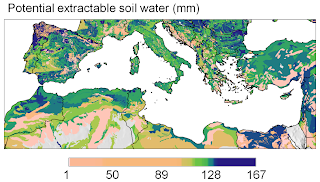
Olive is of major eco-social importance for the desertification-prone Mediterranean Basin, a climate change and biodiversity hotspot of global relevance where remarkable climate change is expected over the next few decades with unknown ecosystem impacts. However, climate impact assessments have long been constrained by a narrow methodological basis (ecological niche models, ENMs) that is correlative and hence largely omits key impact drivers such as trophic interactions and the effect of water availability. To bridge this gap, mechanistic approaches such as physiologically-based weather-driven demographic models (PBDMs) may be used as they embed by design both the biology of trophic interactions and a mechanistic representation of soil water balance. Here we report progress towards assessing climate effects on olive culture across the Mediterranean region using mechanistic PBDMs that project regionally the multitrophic population dynamics of olive and olive fly as affected by daily wea...

Sardinia olive systems in a warmer climate

Image
In the Mediterranean Basin, major islands including Sardinia are considered particularly vulnerable to global warming and desertification. We used a physiologically based demographic model (PBDM) of olive and olive fly to analyze in detail this plant-pest system in Sardinia under observed weather (ten years of daily data from 48 locations), three climate warming scenarios (increases of 1, 2 and 3 °C in average daily temperature), and a 105-year climate model scenario for the Alghero (e.g. 1951-2055). GRASS GIS was used to map model predictions, and model calibration with field bloom date data was performed to increase simulation accuracy of olive flowering predictions under climate change. As climate warms, the range of olive is predicted to expand to higher altitudes and consolidate elsewhere, especially in coastal areas. The range of olive fly will extend into previously unfavorable cold areas, but will contract in warm inland lowlands where temperatures approach its upper thermal li...

Can climate change influence olive pests and diseases?

Image
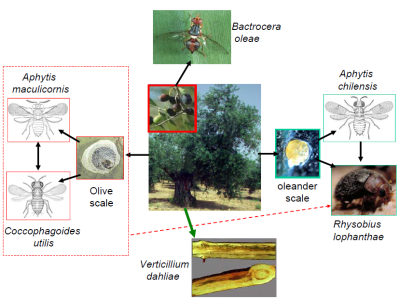
Climate change will make the Mediterranean Basin vulnerable to desertification, and this will affect many species such as olive in largely unknown ways. Olive is the base of a tri-trophic food web that includes pest, disease and their natural enemy species, each of which will be affected differently by climate change. The effects of extant weather and climate change scenarios on the tri-trophic interactions can be examined using biologically-rich physiologically-based demographic models developed from field and laboratory data. Studies from Sardinia, Italy and California show how the same model can be applied to these areas, and by inference, to other areas of the Mediterranean basin and elsewhere globally. Specifically, the model enables the examination of climate change on the range of olive and olive fly. The effect of climate change on natural enemies are illustrated using the olive scale/parasitoid interactions. The same system can also be used to examine the distribution and abu...

Mediterranean-wide analysis of the olive-olive fly system

Image
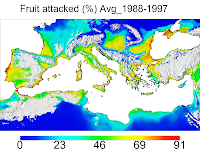
The Mediterranean Basin is expected to be particularly vulnerable to climate change including pronounced climate warming and desertification. Olive ( Olea europaea ) is of eco-social importance in the Mediterranean where it was domesticated, and it is also considered a sensitive climate indicator. This crop and its major pest, the olive fly Bactrocera oleae are a suitable model system to study Mediterranean climate. A weather-driven physiologically-based demographic model (PBDM) of olive and olive fly ( http://cnr.berkeley.edu/casas/ ) is being used to analyze this plant-pest system in the Mediterranean region based on ERA-40 weather data ( http://www.ecmwf.int/ ) downscaled via the regional climate model RegCM3 coupled to the MIT ocean model. PBDM predictions are mapped with the open source GIS GRASS ( http://grass.osgeo.org/ ). Ponti L., Gutierrez A.P., Ruti P.M., 2009. The olive– Bactrocera oleae system in the Mediterranean Basin: a physiologically based analysis driven by the...