Posts

Showing posts with the label holistic analysis

Earth observation: bridging the gap to crop-pest systems

Image
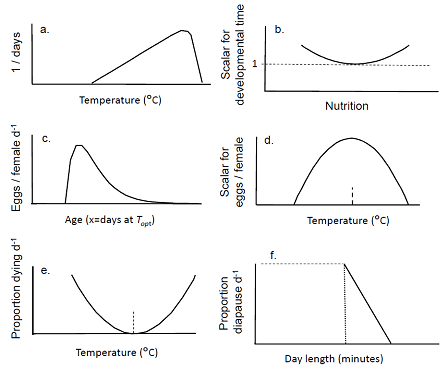
The workshop " When Space Meets Agriculture " aimed at promoting a better understanding of the significance and potential of Europe’s space systems (EGNOS/Galileo and Copernicus) for the agricultural sector. While introducing Rural Development Programmes of selected regions and exploring opportunities to set synergies for the development of space applications for the agriculture sector, it will present the main strands of the European Agriculture Policy and more generally link the space community to the agriculture community. Our contribution identified recent and prospective holistic analyses of climate change effects on crop-pest systems in the Mediterranean Basin. The approach used in the analyses involves using physiologically based demographic modeling (PBDM) of crop-pest-natural enemy interactions in the context of a geographic information system (GIS). A major goal is to link the PBDM/GIS technology with increasingly available biophysical datasets from global modeling ...
Traditional farming and the Mediterranean diet

Image
The Mediterranean diet is described by the UNESCO Cultural Heritage of Humanity website ( http://www.unesco.org/culture/ich/en/RL/00884 ) as encompassing more than just food of the various cultures. These diets are embedded in bio-cultural landscapes that are at risk from global markets, industrial agriculture, invasive species and climate change, and yet little research aimed at conserving this Mediterranean agricultural heritage is being conducted. A focus on preserving traditional Mediterranean agricultural systems provides unique opportunities to link UNESCO-SCBD’s Joint Programme on Biological and Cultural Diversity ( http://www.cbd.int/lbcd/ ​) and FAO’s Globally Important Agricultural Heritage Systems initiative (GIAHS, http://www.fao.org/giahs/ ) with the goal of developing strategies and policy to preserve this heritage and the food production systems that are its basis for future generations. An important step in this direction is the development of holistic ecosystem-level a...

PBDMs for evidence-based pest risk assessment

Image
The distribution and abundance of species that cause economic loss (i.e., pests) in crops, forests or livestock depends on many biotic and abiotic factors that are thought difficult to separate and quantify on geographical and temporal scales. However, the weather-driven biology and dynamics of such species and of relevant interacting species in their food chain or web can be captured via mechanistic physiologically based demographic models (PBDMs) that can be implemented in the context of a geographic information system (GIS) to project their potential geographic distribution and relative abundance given observed or climate change scenarios of weather. PBDMs may include bottom-up effects of the host on pest dynamics and, if appropriate, the top-down action of natural enemies. When driven by weather, PBDMs predict the phenology, age structure and abundance dynamics at one or many locations enabling projecting the distribution of the interacting species across wide geographic areas. PBD...

Indian cotton: weather, yields and suicides

Image
Cotton with coevolving pests has been grown in India for more than 5000 years. Hybrid cotton was introduced in the 1970s with increases in fertilizer and in insecticide use against pink bollworm that caused outbreaks of bollworm. Hybrid Bt cotton, introduced in 2002 to control bollworm and other lepidopteran pests, is grown on more than 90 % of the cotton area. Despite initial declines, year 2013 insecticide use is at 2000 levels, yields plateaued nationally, and farmer suicides increased in some areas. Biological modeling of the pre-1970s cotton/pink bollworm system was used to examine the need for Bt cotton, conditions for its economic viability, and linkage to farmer suicides. Yields in rainfed cotton depend on timing, distribution, and quantity of monsoon rains. Pink bollworm causes damage in irrigated cotton, but not in rainfed cotton unless infested from irrigated fields. Use of Bt cotton seed and insecticide in rainfed cotton is questionable. Bt cotton may be economic in irrigat...

MED Solutions

Image
Launched by UN Secretary-General Ban Ki-moon in August 2012, the Sustainable Development Solutions Network (SDSN) mobilizes scientific and technical expertise from academia, civil society, and the private sector in support of sustainable development problem solving at local, national, and global scales. SDSN is chaired by Jeffrey Sachs from Columbia University (for more details see unsdsn.org ). University of Siena coordinates the SDSN Regional hub for the Mediterranean (MED Solutions). The second MED Solutions conference was held in Siena on 5-6 March 2015 ( http://www.sdsnmedconf.unisi.it ). One of the four Solutions for Agri-Food Sustainability selected and presented at the conference was "SPMP-MED: A Sustainable Pest Management technological Platform for the MEDiterranean basin" (see presentation by Dr. Gianni Gilioli linked below) that includes an approach not unlike that used by the GlobalChangeBiology project. The Mediterranean basin is a biodiversity hotspot character...

Holistic approach in invasive species research

Image
The Mediterranean Basin is a climate change and biological invasion hotspot where recent warming is facilitating the establishment and spread of invasive species, one of which is the highly destructive South American tomato leafminer ( Tuta absoluta ). This pest recently invaded the Mediterranean Basin where it threatens solanaceous crops. Holistic approaches are required to project the potential geographic distribution and relative abundance of invasive species and hence are pivotal to developing sound policy for their management. This need is increasing dramatically in the face of a surge in biological invasions and climate change. However, while holistic analyses of invasive species are often advocated, they are rarely implemented. We propose that physiologically-based demographic models (PBDMs) in the context of a geographic information system (GIS) can provide the appropriate level of synthesis required to capture the complex interactions basic to manage invasive species such as T...