Posts

Showing posts with the label agroecosystem analysis

Bio-economics of Indian hybrid Bt cotton and farmer suicides

Image
Background. The implementation of hybrid Bt cotton unique to India has been heralded as a grand success by government agencies, seed companies and other proponents, and yet yields have stagnated at low levels and production costs have risen 2.5–3-fold. The low-yield hybrid cotton system of India contributes thousands of farmer suicides to the annual national toll. Conceptual and methodological barriers have hindered bioeconomic analysis of the ecological and social sustainability of such cross-scale agro-ecological problems in time and geographic space, under global technology and climate change. As a paradigm shift, we use conceptually simple, parameter-sparse, theoretically based, mechanistic, weather-driven physiologically based demographic models (PBDMs) to deconstruct the bio-economics of the Indian cotton system. Results. Our analysis of Indian hybrid cotton system explains some extant ecological and economic problems, and suggests a viable solution. Specifically, the model accur...

Bio-economic analysis of coffee berry borer control

Image
 Coffee, after petroleum, is the most valuable commodity globally in terms of total value (harvest to coffee cup). Here, our bioeconomic analysis considers the multitude of factors that influence coffee production. The system model used in the analysis incorporates realistic field models based on considerable new field data and models for coffee plant growth and development, the coffee/coffee berry borer (CBB) dynamics in response to coffee berry production and the role of the CBB parasitoids and their interactions in control of CBB. Cultural control of CBB by harvesting, cleanup of abscised fruits, and chemical sprays previously considered are reexamined here to include biopesticides for control of CBB such as entomopathogenic fungi (Beauveria bassiana, Metarhizium anisopliae) and entomopathogenic nematodes (Steinernema sp., Heterorhabditis). The bioeconomic analysis estimates the potential of each control tactic singly and in combination for control of CBB. The analysis explains ...

International agroecology short course

Image
There is no doubt that humanity needs an alternative agricultural development paradigm, one that encourages more ecologically sound, biodiverse, resilient, sustainable, and socially just forms of agriculture. The basis for such new systems are the myriad of ecologically based agricultural styles developed on hundreds of millions small farms that produce a large share of the food consumed today in the world, mostly without agrochemicals. Agroecology represents this paradigm: a dialogue of wisdoms between traditional agricultural knowledges and modern agricultural sciences that uses ecological concepts and principles for the design and management of sustainable agroecosystems where external inputs are replaced by natural processes. This international Agroecology short course was held from May 2nd to 5th, 2018 at the Center for “Climate Change and Biodiversity in Lakes and Wetlands” located on Polvese Island , Lake Trasimeno, Umbria (Italy), and was designed for scholars, students, farmer...

Invasive species and climate change: the PBDM approach

Image
Assessing the geographic distribution and abundance of invasive species is critical for developing sound management and/or eradication policies. Ecological niche modelling approaches (ENMs) that make implicit assumptions about biology and mathematics are commonly used to predict the potential distribution of invasive species based on their recorded distribution. An alternative approach is physiologically based demographic modelling (PBDM), which explicitly incorporates the mathematics and the observed biology, including trophic interactions, to predict the temporal phenology and dynamics of a species across wide geographic areas. The invasive weed, yellow starthistle (YST) (Centaurea solstitialis), and its interactions with annual grasses and herbivorous biological control agents is used to demonstrate the utility of the PBDM approach for analysing complex invasive species problems. The PBDM predicts the distribution and relative abundance of YST accurately across the western USA, and ...

Analysis of invasive insects: links to climate change

Image
Climate change is expected to alter the geographic distribution and abundance of many species, to increase the invasion of new areas by exotic species and, in some cases, to lead to extinction of species. This chapter reviews some of the links between invasive insects and climate change. The effects of climate change on insect pest populations can be direct, through impacts on their physiology and behaviour, or indirect, through biotic interactions (i.e. bottom-up and top-down eff ects). Anthropogenic climate and global change is expected to be a major driver in the introduction, establishment, distribution, impact and changes in the efficacy of mitigation strategies for invasive species. To address these problems, we must be able to predict climate change impacts on species distribution and abundance. Commonly used ecological niche modelling approaches have implicit assumptions about the biology of the target species and attempt to characterize the ecological niche using aggregate wea...

Invasive species: why the biology matters

Image
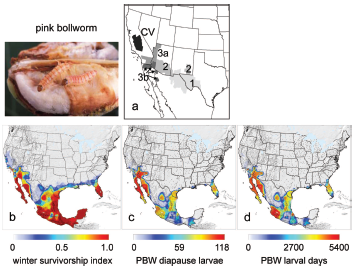
Using published bi- and tri-trophic physiologically-based demographic system models having similar sub components, the geographic distributions and relative abundance (a measure of invasiveness) of six invasive herbivorous insect species is assessed prospectively across the United States and Mexico. The models used are mechanistic descriptions of the weather-driven biology of the species. The plant hosts and insect species included in the study are: (1) cotton/pink bollworm, (2) a fruit tree host/Mediterranean fruit fly, (3) olive/olive fly, (4) a perennial host/light brown apple moth; (5) grapevine/glassy-winged sharpshooter and its two egg parasitoids, (6) grapevine/European grapevine moth. All of these species are currently or have been targets for eradication. The goal of the analyses is to predict and explain prospectively the disparate distributions of the six species as a basis for examining eradication/containment efforts against them. The eradication of the new world screwworm...

Deconstructing the control of the spotted alfalfa aphid

Image
Control of insect pests and other taxa may be due to many factors that are difficult to separate and quantify as was the case for the control of the spotted alfalfa aphid (SAA, Therioaphis maculata Monell) in California and elsewhere. Introduced parasitoids, host plant resistance, pathogens and native predators led to its successful control, but the relative contribution of each factor remained largely unknown. The relative contribution of each control factor was estimated using a weather-driven physiologically-based demographic system model consisting of alfalfa, SAA (a), its three exotic parasitoids [ Trioxys complanatus (Quilis) (b), Praon palitans Muesebeck (c), and Aphelinus semiflavus Howard (d)], a native coccinellid beetle [ Hippodamia convergens (Guérin-Menéville)], a fungal pathogen [ Erynia neoaphidis Remaudière & Hennebert (Zygomycetes: Entomophthorales) (g)], and host plant resistance (HPR) (h). Alone, each factor failed to control SAA, as did combinations of the ...

Agroecosystems and climate change

Image
In a chapter to appear in the Handbook of Climate Change and Agroecosystems , four approaches used to estimate the potential distribution of native and invasive species in agricultural, natural and medical/veterinary vector/disease systems in the face of climate change are reviewed: (1) time-series observations to document biological responses to changes in climatic variables; (2) remote sensing analysis of data; (3) climate envelope approaches (statistically-based ecological niche models and physiologically-based ecological niche models); (4) physiologically based demographic models. The bases and relative merits of the approaches are discussed. The chapter emphasizes physiologically based demographic models that may be used at the individual, population and regional scales. Such models easily include multiple trophic levels as demonstrated for the olive/olive scale system. The olive/olive-fly system embedded in a geographic information system (GIS) is used to illustrate the utility o...

Sardinia olive systems in a warmer climate

Image
In the Mediterranean Basin, major islands including Sardinia are considered particularly vulnerable to global warming and desertification. We used a physiologically based demographic model (PBDM) of olive and olive fly to analyze in detail this plant-pest system in Sardinia under observed weather (ten years of daily data from 48 locations), three climate warming scenarios (increases of 1, 2 and 3 °C in average daily temperature), and a 105-year climate model scenario for the Alghero (e.g. 1951-2055). GRASS GIS was used to map model predictions, and model calibration with field bloom date data was performed to increase simulation accuracy of olive flowering predictions under climate change. As climate warms, the range of olive is predicted to expand to higher altitudes and consolidate elsewhere, especially in coastal areas. The range of olive fly will extend into previously unfavorable cold areas, but will contract in warm inland lowlands where temperatures approach its upper thermal li...

Mediterranean-wide analysis of the olive-olive fly system

Image
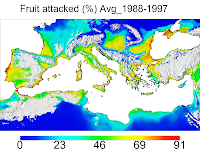
The Mediterranean Basin is expected to be particularly vulnerable to climate change including pronounced climate warming and desertification. Olive ( Olea europaea ) is of eco-social importance in the Mediterranean where it was domesticated, and it is also considered a sensitive climate indicator. This crop and its major pest, the olive fly Bactrocera oleae are a suitable model system to study Mediterranean climate. A weather-driven physiologically-based demographic model (PBDM) of olive and olive fly ( http://cnr.berkeley.edu/casas/ ) is being used to analyze this plant-pest system in the Mediterranean region based on ERA-40 weather data ( http://www.ecmwf.int/ ) downscaled via the regional climate model RegCM3 coupled to the MIT ocean model. PBDM predictions are mapped with the open source GIS GRASS ( http://grass.osgeo.org/ ). Ponti L., Gutierrez A.P., Ruti P.M., 2009. The olive– Bactrocera oleae system in the Mediterranean Basin: a physiologically based analysis driven by the...