Posts

Showing posts with the label Grape

Bioeconomic approach to grape under climate change

Image
( This paper made cover story .) Of fruit crops, grape is the most largely cultivated and has the highest economic importance globally; it is part of the Mediterranean bio-cultural heritage that is threatened by climate change. However, the analysis of the climate effects on grape and other crop and natural ecosystems on a regional scale has been vexing. Here, we review how sparse physiologically based demographic models (PBDM) in the context of the geographic information system GRASS GIS can be used to examine the effects of the extant weather and climate change on the dynamics of the interaction between grape and European grapevine moth across the Euro-Mediterranean region. Further, by including management-relevant complexity in a mechanistic way, the PBDM/GIS system provides the basis for a regional bioeconomic analysis of the grape system and a template for similar analyses that require modest data and funding. Ponti L., Gutierrez A.P., Boggia A., Neteler M., 2018. Analysis of ...

Climate warming effect on grape and grapevine moth

Image
The grapevine moth Lobesia botrana (Den. & Schiff.) (Lepidoptera: Tortricidae) is the principal native pest of grape in the Palearctic region. In the present study, we assessed prospectively the relative abundance of the moth in Europe and the Mediterranean Basin using linked physiologically‐based demographic models for grape and L. botrana . The model includes the effects of temperature, day‐length and fruit stage on moth development rates, survival and fecundity. Daily weather data for 1980–2010 were used to simulate the dynamics of grapevine and L. botrana in 4506 lattice cells across the region. Average grape yield and pupae per vine were used as metrics of favourability. The results were mapped using the grass Geographic Information System ( http://grass.osgeo.org ). The model predicts a wide distribution for L. botrana with highest populations in warmer regions in a wide band along latitude 40°N. The effects of climate warming on grapevine and L. botrana were explored usi...

MED-GOLD project proposal selected for funding

Image
MED-GOLD ( Turning climate-related information into added value for traditional MEDiterranean Grape, OLive, and Durum wheat food systems ) will demonstrate the proof-of-concept for climate services in the agriculture sector by developing case studies for three hallmarks of the Mediterranean food system: grapes, olives, and durum wheat.  Agriculture is primarily climate-driven and hence highly vulnerable to climate variability and change. Evidence suggests that the Mediterranean region is under immediate threat of shifting climate patterns and the associated ecological, economic and social effects. Developing a capacity to turn the increasingly big climate-related data into tailored climate services that can inform decision-making in agriculture is, therefore, a priority both in Europe and worldwide. The long-term goal of this project is to make European agriculture and food systems more competitive, resilient, and efficient in the face of climate change, by using climate serv...

Agrobiodiversity in a changing world

Image
Exotic species that invade new areas cause economic loss annually nearly tenfold that of natural disasters. The economic impact of such biological invasions has been considerable also in agriculture, with many major agricultural pests being invasive species, which number is expected to increase given the combined action of climate warming and globalization, particularly in the Mediterranean Basin. This region is rich in natural and agricultural biodiversity but also considerably vulnerable to biological invasions that threaten key elements of Mediterranean agro-biodiversity such as the traditional perennial crops grape and olive. Currently, most major threats to grape and olive culture are invasive species - often vector borne diseases so serious that the only control method is removal and destruction of infected crop plants. However, how to assess the potential impact of such invasive threats, and hence how to manage them, remains an unresolved and largely unexplored problem. Gaps exi...

Agriculture, food security and climate change in Europe

Image
The GlobalChangeBiology project is part of the Joint Programming Initiative on Agriculture, Food Security and Climate Change ( FACCE – JPI ) funded by the European Union under the 7th Framework Program. The goal of FACCE – JPI is to achieve, support and promote integration, alignment and joint implementation of national resources under a common research and innovation strategy to address the diverse challenges in agriculture, food security and climate change. Partnering MACSUR , the first pilot action of FACCE – JPI that will start officially in June 2012 (see first newsletter ), the GlobalChangeBiology project will provide case studies on grape and olive systems in the Mediterranean Basin. The MACSUR project is a knowledge hub that brings together 73 research groups from across Europe and will provide a detailed climate change risk assessment for European agriculture and food security, in collaboration with international projects including the GlobalChangeBiology project . As...

Prospective analysis of European grapevine moth

Image
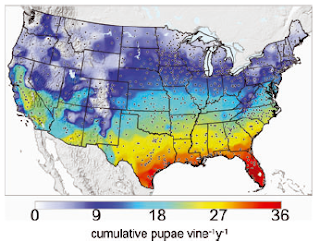
The polyphagous European grapevine moth Lobesia botrana (Den. & Schiff.) is the principal native pest of grape berries in the Palearctic region. It was found in Napa County, California, in 2009, and it has subsequently been recorded in an additional nine counties, despite an ongoing eradication program. A holistic physiologically-based demographic model for L. botrana linked to an extant mechanistic model of grapevine was run using observed daily weather data to simulate and map (via GRASS GIS ) the potential distribution of the moth in California and the continental U.S.A. The model predicts L. botrana can spread statewide with the highest populations expected in the hotter regions of southern California and the lower half of the Central Valley. In the U.S.A., areas of highest favorability include south Texas, and much of the southeast U.S.A. With climate warming, L. botrana abundance is expected to increase in northern California and in the agriculturally rich Central Valley ...

Analysis of the glassy-winged sharpshooter system

Image
The capacity to predict the geographic distribution and relative abundance of invasive species is pivotal to developing policy for eradication or control and management. An example is the glassy-winged sharpshooter Homalodisca vitripennis (Germar) (GWSS) in California which vectors the bacterial pathogen Xylella fastidiosa (Wells) that causes Pierce’s disease in grape and scorch-like diseases in other plants. A weather driven demographic model of grape, GWSS, its two parasitoids ( Gonatocerus ashmeadi Girault and G. triguttatus Girault) and the pathogen was developed to show how the geographic distribution and abundance of GWSS as affected by weather and natural enemies in California can be easily assessed. The distribution of X. fastidiosa is limited to the warm inland areas of southern California. Biological control of GWSS further decreases the pathogen's relative range. Two climate warming scenarios show that increasing temperatures will increase GWSS severity in the agric...

Project summary

Analytical tools that provide a synthesis of ecological data are increasingly needed to design and maintain sustainable agroecosystems increasingly disrupted by global change in the form of agro-technical inputs, invasive species, and climate change. This is particularly relevant to the Mediterranean Basin, a climate change hot-spot already threatened by local environmental changes including desertification. The project will provide important tools for summarizing, managing, and analyzing ecological data in agricultural systems to address global change effects using grape and olive as model systems. The project will integrate weather driven physiologically based Ecosystem Modelling (EM) and Geographic Information Systems (GIS) to derive a dynamic understanding of complex agricultural systems in the face of global change including climate warming. Multivariate analyses will be used to summarize the main effect of model predictions in a space and time independent way to provide a solid b...