Posts

Asian citrus psyllid and citrus greening disease
Image
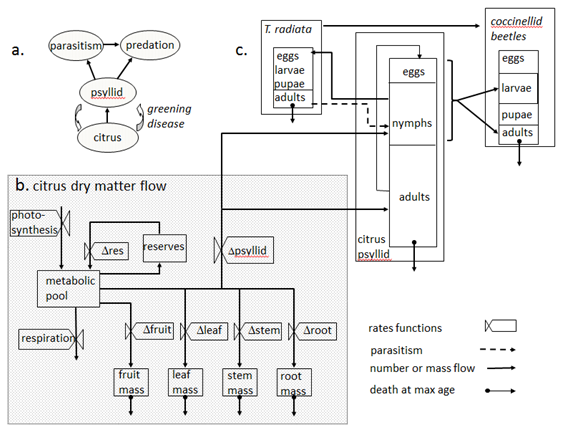
The invasive Asian citrus psyllid Diaphorina citri Kuwayama vectors the bacterial pathogen ‘Candidatus Liberibacter asiaticus’ that is the putative causal agent of citrus greening disease (Huanglongbing disease) in citrus in many areas of the world. The capacity to predict the potential geographic distribution, phenology and relative abundance of the pest and disease is pivotal to developing sound policy for their management. A weather-driven physiologically based demographic model (PBDM) system is developed that summarizes the available data in the literature, and used to assess prospectively the geographic distribution and relative abundance of citrus, the psyllid, its parasitoid ( Tamarixia radiata Waterston), and citrus greening disease in North America and the Mediterranean Basin. The potential for natural and biological control of citrus psyllid is examined prospectively. Gutierrez A.P., Ponti L., 2013. Prospective analysis of the geographic distribution and relative abundance...
Invasive species: why the biology matters

Image
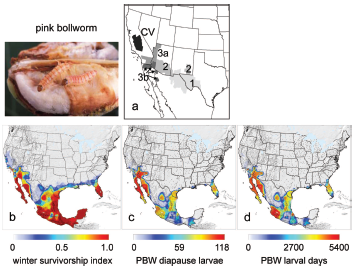
Using published bi- and tri-trophic physiologically-based demographic system models having similar sub components, the geographic distributions and relative abundance (a measure of invasiveness) of six invasive herbivorous insect species is assessed prospectively across the United States and Mexico. The models used are mechanistic descriptions of the weather-driven biology of the species. The plant hosts and insect species included in the study are: (1) cotton/pink bollworm, (2) a fruit tree host/Mediterranean fruit fly, (3) olive/olive fly, (4) a perennial host/light brown apple moth; (5) grapevine/glassy-winged sharpshooter and its two egg parasitoids, (6) grapevine/European grapevine moth. All of these species are currently or have been targets for eradication. The goal of the analyses is to predict and explain prospectively the disparate distributions of the six species as a basis for examining eradication/containment efforts against them. The eradication of the new world screwworm...

Process-based soil water balance for olive

Image
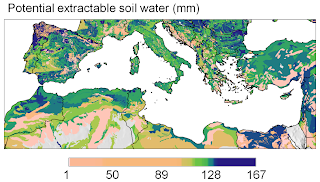
Olive is of major eco-social importance for the desertification-prone Mediterranean Basin, a climate change and biodiversity hotspot of global relevance where remarkable climate change is expected over the next few decades with unknown ecosystem impacts. However, climate impact assessments have long been constrained by a narrow methodological basis (ecological niche models, ENMs) that is correlative and hence largely omits key impact drivers such as trophic interactions and the effect of water availability. To bridge this gap, mechanistic approaches such as physiologically-based weather-driven demographic models (PBDMs) may be used as they embed by design both the biology of trophic interactions and a mechanistic representation of soil water balance. Here we report progress towards assessing climate effects on olive culture across the Mediterranean region using mechanistic PBDMs that project regionally the multitrophic population dynamics of olive and olive fly as affected by daily wea...

Modeling life on earth @ EuroPython 2013

Image
"Modeling life on Earth: an object-oriented challenge", a lighting talk given at EuroPython in Florence on July 3rd, 2013. Thanks to the Python community for support.

Deconstructing the control of the spotted alfalfa aphid

Image
Control of insect pests and other taxa may be due to many factors that are difficult to separate and quantify as was the case for the control of the spotted alfalfa aphid (SAA, Therioaphis maculata Monell) in California and elsewhere. Introduced parasitoids, host plant resistance, pathogens and native predators led to its successful control, but the relative contribution of each factor remained largely unknown. The relative contribution of each control factor was estimated using a weather-driven physiologically-based demographic system model consisting of alfalfa, SAA (a), its three exotic parasitoids [ Trioxys complanatus (Quilis) (b), Praon palitans Muesebeck (c), and Aphelinus semiflavus Howard (d)], a native coccinellid beetle [ Hippodamia convergens (Guérin-Menéville)], a fungal pathogen [ Erynia neoaphidis Remaudière & Hennebert (Zygomycetes: Entomophthorales) (g)], and host plant resistance (HPR) (h). Alone, each factor failed to control SAA, as did combinations of the ...

Agriculture, food security and climate change in Europe

Image
The GlobalChangeBiology project is part of the Joint Programming Initiative on Agriculture, Food Security and Climate Change ( FACCE – JPI ) funded by the European Union under the 7th Framework Program. The goal of FACCE – JPI is to achieve, support and promote integration, alignment and joint implementation of national resources under a common research and innovation strategy to address the diverse challenges in agriculture, food security and climate change. Partnering MACSUR , the first pilot action of FACCE – JPI that will start officially in June 2012 (see first newsletter ), the GlobalChangeBiology project will provide case studies on grape and olive systems in the Mediterranean Basin. The MACSUR project is a knowledge hub that brings together 73 research groups from across Europe and will provide a detailed climate change risk assessment for European agriculture and food security, in collaboration with international projects including the GlobalChangeBiology project . As...

Course on open source geospatial software

Image
The ENEA Technical Unit for Sustainable Development and Agro-industrial Innovation ( UTAGRI ) organized a course on "Using open source software for remote sensing and GIS applications" sponsored by the GlobalChangeBiology project and taught by Dr. Markus Neteler, head of the GIS and Remote Sensing Unit at Fondazione Edmund Mach (Trento, Italy). The course was held at the ENEA Casaccia Research Center and spanned two days of intensive work (17-18 January 2012). After an introduction to open source GIS, the course moved to practical issues such as software installation, data import and a simple analysis. The remote sensing part started with a review of available data sets, followed by an overview on data import and processing (analysis of time series and classification). Database management was also covered with a focus on SQL, which introduced vector data editing. Last, the GRASS-R interface was illustrated. Even though the course was targeted to ENEA researchers, it attra...