Posts

PBDMs for evidence-based pest risk assessment

Image
The distribution and abundance of species that cause economic loss (i.e., pests) in crops, forests or livestock depends on many biotic and abiotic factors that are thought difficult to separate and quantify on geographical and temporal scales. However, the weather-driven biology and dynamics of such species and of relevant interacting species in their food chain or web can be captured via mechanistic physiologically based demographic models (PBDMs) that can be implemented in the context of a geographic information system (GIS) to project their potential geographic distribution and relative abundance given observed or climate change scenarios of weather. PBDMs may include bottom-up effects of the host on pest dynamics and, if appropriate, the top-down action of natural enemies. When driven by weather, PBDMs predict the phenology, age structure and abundance dynamics at one or many locations enabling projecting the distribution of the interacting species across wide geographic areas. PBD...

New agroecology book in Italian

Image
Agroecology: a viable agricultural path for a planet in crisis. It is now clear that humanity needs an alternative agricultural development paradigm, one that encourages more ecologically, biodiverse, resilient, sustainable and socially just forms of agriculture. The basis for this new systems are the myriad of ecologically based agricultural styles developed by over a billion smallholders, family farmers and indigenous people on hundreds of millions of small farms which currently produce most of the global agricultural output for domestic consumption largely without agrochemicals. Agroecology is this paradigm: a dialogue between traditional agricultural knowledge and modern agricultural science that uses ecological concepts and principles for designing and managing sustainable agroecosystems in which external inputs are replaced by natural processes such as natural soil fertility and biological control. This book explains why agroecology is the most robust food provisioning pathway fo...

Indian cotton: weather, yields and suicides

Image
Cotton with coevolving pests has been grown in India for more than 5000 years. Hybrid cotton was introduced in the 1970s with increases in fertilizer and in insecticide use against pink bollworm that caused outbreaks of bollworm. Hybrid Bt cotton, introduced in 2002 to control bollworm and other lepidopteran pests, is grown on more than 90 % of the cotton area. Despite initial declines, year 2013 insecticide use is at 2000 levels, yields plateaued nationally, and farmer suicides increased in some areas. Biological modeling of the pre-1970s cotton/pink bollworm system was used to examine the need for Bt cotton, conditions for its economic viability, and linkage to farmer suicides. Yields in rainfed cotton depend on timing, distribution, and quantity of monsoon rains. Pink bollworm causes damage in irrigated cotton, but not in rainfed cotton unless infested from irrigated fields. Use of Bt cotton seed and insecticide in rainfed cotton is questionable. Bt cotton may be economic in irrigat...

Agrobiodiversity in a changing world

Image
Exotic species that invade new areas cause economic loss annually nearly tenfold that of natural disasters. The economic impact of such biological invasions has been considerable also in agriculture, with many major agricultural pests being invasive species, which number is expected to increase given the combined action of climate warming and globalization, particularly in the Mediterranean Basin. This region is rich in natural and agricultural biodiversity but also considerably vulnerable to biological invasions that threaten key elements of Mediterranean agro-biodiversity such as the traditional perennial crops grape and olive. Currently, most major threats to grape and olive culture are invasive species - often vector borne diseases so serious that the only control method is removal and destruction of infected crop plants. However, how to assess the potential impact of such invasive threats, and hence how to manage them, remains an unresolved and largely unexplored problem. Gaps exi...

Risk assessment for tiger mosquito in Europe

Image
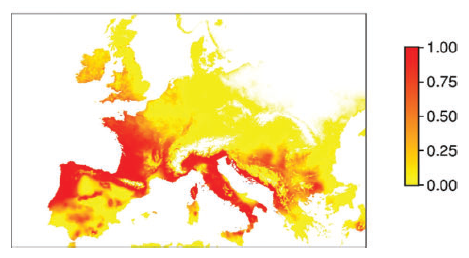
The Asian tiger mosquito ( Ae. albopictus ) is indigenous to the oriental region, but is now widespread throughout the world. It is an aggressive mosquito, which causes nuisance and is well known vector of important human disease. It is one of the world’s most invasive species and is now invading Europe by both natural means and human assisted dispersal. Currently, there is no consensus on the limits of its potential geographic distribution in Europe. For this reason, studying the role that environmental driving variables, mainly temperature, play in determining the spatial variation of the potential population abundance of the mosquito should be considered a high priority. To assess the risk posed by Ae. albopictus to Europe, a lattice model based on the temperature-dependent physiologically based demographic modelling approach has been developed and is being tested against field observations. The area of potential distribution of this insect is simulated as driven by current climate...

MED Solutions

Image
Launched by UN Secretary-General Ban Ki-moon in August 2012, the Sustainable Development Solutions Network (SDSN) mobilizes scientific and technical expertise from academia, civil society, and the private sector in support of sustainable development problem solving at local, national, and global scales. SDSN is chaired by Jeffrey Sachs from Columbia University (for more details see unsdsn.org ). University of Siena coordinates the SDSN Regional hub for the Mediterranean (MED Solutions). The second MED Solutions conference was held in Siena on 5-6 March 2015 ( http://www.sdsnmedconf.unisi.it ). One of the four Solutions for Agri-Food Sustainability selected and presented at the conference was "SPMP-MED: A Sustainable Pest Management technological Platform for the MEDiterranean basin" (see presentation by Dr. Gianni Gilioli linked below) that includes an approach not unlike that used by the GlobalChangeBiology project. The Mediterranean basin is a biodiversity hotspot character...

Remote sensing and invasive species

Image
A crucial step in evaluating the impact of invasive species is to map changes in their actual and potential distribution and relative abundance across wide regions over an appropriate time span. While direct and indirect remote sensing approaches have long been used to assess the invasion of plant species, the distribution of invasive animals is mainly based on indirect methods that rely on environmental proxies of conditions suitable for colonization by a particular species. The aim of this article is to review recent efforts in the predictive modelling of the spread of both plant and animal invasive species using remote sensing, and to stimulate debate on the potential use of remote sensing in biological invasion monitoring and forecasting. Rocchini D., Andreo V., Förster M., Garzon-Lopez C.X., Gutierrez A.P., Gillespie T.W., Hauffe H.C., He K.S., Kleinschmit B., Mairota P., Marcantonio M., Metz M., Nagendra H., Pareeth S., Ponti L., Ricotta C., Rizzoli A., Schaab G., Zebisch M., Z...